Emergence and Persistent Dominance of SARS-CoV-2 Omicron BA.2.3.7 Variant, Taiwan
Published in Emerging Infectious Diseases, 2023
Recommended citation: Pei-Lan Shao*, Hsiao-Chen Tu*, Yu-Nong Gong*, Hung-Yu Shu, Ralph Kirby, Li-Yun Hsu, Hui-Yee Yeo, Han-Yueh Kuo, Yi-Chia Huang, Yung-Feng Lin, Hui-Ying Weng, Yueh-Lin Wu, Chien-Chih Chen, Tzen-Wen Chen, Kuo-Ming Lee, Chung-Guei Huang, Shin-Ru Shih, Wei J Chen, Chen-Chi Wu, Chong-Jen Yu, Shih-Feng Tsai (2023). Emerging Infectious Diseases 29(4):792–796. https://wwwnc.cdc.gov/eid/article/29/4/22-1497_article
📸 Key Result/Figure
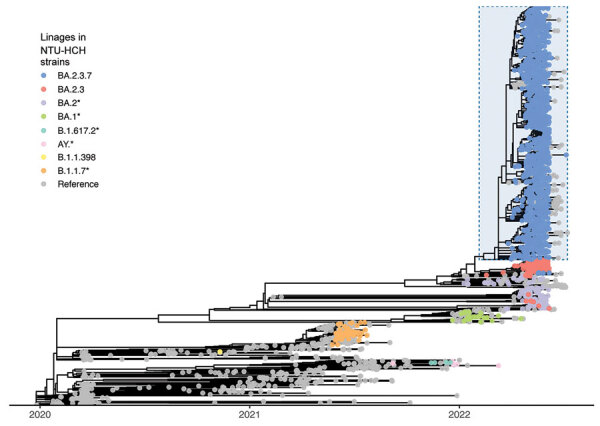
- Figure 2. Phylogenetic analysis of SARS-CoV-2 sequences based on 1,966 sequences from the NTU-HCH surveillance program in Taiwan and 881 sequences from GISAID (https://www.gisaid.org). Lineages of NTU-HCH strains are annotated in different colors; asterisks (*) represent the collection of a specific lineage with its sublineage. The BA.2.3.7 strains were dominantly circulating in Taiwan from March 2022, highlighted by light blue in the tree. NTU-HCH, National Taiwan University Hospital–Hsinchu Branch.